


Planar Stripline Design

Kapton® Dielectric

Cryogenic Flexibility

Ag or NbTi

8-Channel Flex
Want To Know More
Materials

-
Standard (Ag) platform
-
Superconducting (NbTi) platform
-
Flexible and durable

Dimensions
-
Ultra Thin
-
Length up to 100cm
-
Designed for cryostats

Microwave Performance
-
S-parameters
-
Crosstalk
-
Impedance
_edited.png)
Thermal Performance
-
Heatloads
-
Simulations
-
Active/Passive Components

Superconducting (NbTi) platform
Superconducting Cri/oFlex® based on NbTi. The superconducting stripline has two major advantages, the reduction of transmission loss and the reduction of the heat load. Superconducting materials not only have zero electrical resistance at temperatures below Tc but also close to zero heat conductivity. These cables are designed to handle up to several tens of milliamps of continuous current while superconducting. The critical temperature is around 9 K and the critical current over 150 mA.
.webp)
Standard (Ag) platform
Cri/oFlex® workhorse material platform is silver (Ag). With the small cross-section it provides an optimal balance between low passive heat load and good transmission, well suited for temperatures that are too high for superconductors.
About the Core Technology
Superconducting Flex Core Technology
The typical Polyimide [Kapton®] layer thickness of a few tens of um is used as dielectric. Polyimide [Kapton®] is ideal material serving two purposes. First, it has great adhesive properties and allows to work with several metals. Second, its cryogenic compatibility and low thermal expansion coefficient makes Kapton® widely used for low temperature applications. The ground planes are made of the conducting or superconducting layers of metal depending on the functionality providing high frequency shielding.
.png)
Optimized Thermal-RF Balance
Engineered to minimize heat load while maintaining strong transmission, supporting clean signals without unnecessary thermal penalty.
100%
Unique Flex-Tech
100%
Optimized Heat
100%
Cost Efficient
What We Do
Core Cryogenic Technology Built for Strict Requirements
By balancing thermal efficiency with high-quality transmission, we help teams meet demanding technical goals while keeping implementation practical and cost-effective. We develop superconducting flex solutions specifically for cryogenics, combining durability, flexibility, and performance in one standardized platform.
In-House Parameter Control
We control conductor thickness, channel width, and channel pitch to match electrical and mechanical requirements with consistent repeatability.
8-Channel Stripline Standard
Each standard flex contains eight channels, with pitch spacing selectable from 0.1 mm to 1 mm for optimized routing and density.
Dimensions
Precision-Controlled Stripline Dimensions for Cri/oFlex®
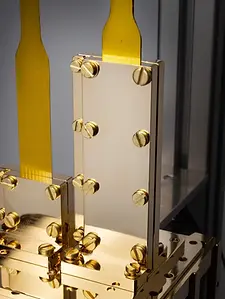
Conducting strips are deposited and patterned as circuits on a shared dielectric layer. Because Cri/oFlex® is produced fully in-house, we can define and control key thin-film parameters such as conductor thickness, individual channel width, and the pitch between channels. A standard Cri/oFlex® stripline includes 8 channels per flex with adjustable pitch, while conductor geometry can be tuned from nanometer-scale films up to tens of microns to meet functional requirements. Flexible section length is available across a broad range, with extended lengths achievable using Tabbi/™ interconnects.
Length Scales with Tabbi/™
Flexible sections can be built from 5 to 100 cm, with extended lengths beyond one meter enabled using Tabbi/™ interconnect.
5–100cm
Flex Length
>10mm
Flex Width
0.3 mm
Thickness
Standard Dimensions
Compact Form Factor with Tunable Geometry
Cri/oFlex® combines high channel density with a compact footprint, while allowing geometric tuning where needed. Pitch, conductor width, thickness, and total length can be configured to balance routing constraints, transmission targets, and system integration requirements.nducting flex solutions specifically for cryogenics, combining durability, flexibility, and performance in one standardized platform.
Cryogenic Low-Loss Transmission
Resistive losses reduce strongly at 4 K, enabling efficient signal delivery, with superconducting flexes minimizing loss even further.
50 Ohm Controlled Impedance
Designed for standard RF systems, maintaining impedance consistency for stable microwave performance across the signal path.
Microwave Performance
Low-Loss, Shielded 50 Ohm Transmission for Cryogenic RF
Microwave transmission is primarily set by dielectric and resistive losses. At cryogenic temperatures, resistive losses drop significantly and become negligible for superconducting Cri/oFlex®. Each flex is designed for 50 Ohm impedance, and the top and bottom ground planes are tied together through a dense via network to strengthen shielding, improve channel-to-channel isolation, and reduce sensitivity to external electrical interference.
Via-Linked Ground Shielding
A via network connects ground planes to enhance isolation, suppress external interference, and improve shielding between adjacent channels.
7 dB/m
Ag at 4 K (10 GHz)
>10mm
NbTi at 4 K (6 GHz)
60 dB
Crosstalk
@ 10 GHz
Crosstalk and Isolation
High Line Density with Excellent Channel Isolation
High-density microwave routing often raises concerns about crosstalk, but multichannel Cri/oFlex® supports tight channel spacing while maintaining strong isolation. Measured near-end and far-end crosstalk across an 8-channel flex remains below -60 dB up to 10 GHz even in worst-case adjacent-channel conditions, with NbTi flexes showing comparable performance.
Transmission Properties
The transmission of Cri/oFlex® can be as low as 1.5 dB/m at 6 GHz for NbTi. For our Silver (Ag) platform a typical 6 dB/m at 6 GHz at low temperatures is normal. In the field these losses are denoted as insertion losses.
On the graph the Silver transmission is plotted for different temperatures.
Below the transmission are the S11 reflections graphs shown. These are known in the field as reflection losses, as they appear as reflections for the system. The Cri/oFlex® is overall well below 15 dB for each reflection. For more information contact our engineering team.

Cross Talk
Cross talk is what we experience daily. Whether it is picking up unwanted conversations in the train, or a phone connection suffering from interference.
Cri/oFlex® has been designed such that each qubit is addressed individually.

Stage-by-Stage Heat Load
We simulate dissipative heat load for each segment between cryostat stages to understand where heat is introduced and how it propagates.
Local Heating from Power
Power dissipation from room-temperature pulses depends on component choice and signal power, so we model where heating is generated along the chain.
Thermal Performance
Thermal Modeling to Optimize Heat Load
To account for the thermal behavior of your cryogenic I/O, we use thermal conduction models alongside local heating models from power dissipation. With a given cryostat temperature profile, we can predict the expected temperatures of the Cri/oFlex® and associated components, and estimate the heat load introduced at each stage. This gives clear insight into how the full I/O chain behaves thermally before installation.
.png)
Optimized Component Placement
Attenuators often dissipate the most power, so simulations help place them where sufficient cryostat cooling capacity is available.
100%
100%
100%
Signal Integrity
Noise Rejection
Thermal Efficiency
What We Do
Designing the Right I/O Chain for Your Cooling Budget
This enables smarter choices in components, attenuation strategy, and placement across stages, helping ensure reliable performance within the available cooling power of your cryostat.
System integration
Integration
There is a wide variety of cooling solutions for quantum computing and low temperature experiments, ranging from lab size dilution refrigerators to small 4K table-top systems. As an i/o provider, it is our task to connect quantum devices and cold experiments to the control electronics regardless of the cooling implementation. To that end we have developed standardized solutions that fit (or can be made to fit) all fridges.
Whether you are purchasing a new system or want to refurbish your current system, Cri/oFlex® provides a solution.

Wiring Ports
Have a spare port in your fridge and want to add extra lines or replace an existing wiring port with a higher density cabling solution?We supply vacuum feedthroughs, Thermal clamps, Brackets and Cri/oFlex® laminates for all standard ports you will find in dilution refridgerators.
Out of the box solution
Fits for all standard ports
Upgrade existing systems

Loaders
Delft Circuits can supply fully pre-assembled loaders with Cri/oFlex cabling inside.We supply top- and sideloaders for all common brands such as Bluefors, Oxford and Leiden Cryogenics.
The advantages of pre-assambled loaders:
Plug and play cabling solution
More channels in a loader
Engineered for your application

Turn-Key
Have a spare port in your fridge and want to add extra lines or replace an existing wiring port with a higher density cabling solution?We supply vacuum feedthroughs, Thermal clamps, Brackets and Cri/oFlex® laminates for all standard ports you will find in dilution refridgerators.
Full-service provider
Full fletched solutions
Innovative design

Nano Vacuum delivers world-leading vacuum, micro and nano-fabrication, and quantum-cryogenic solutions for researchers and innovators across Australia and New Zealand.

Copyright © NanoVacuum 2025. All rights reserved.
Phone
1800 560 820
Location
6 / 7 Salisbury Road, Castle Hill, NSW. 2154
Quick Links
Subscribe Newsletter
Subscribe today to hear first about Nano Vacuum's new and exciting technology
Enter your email: